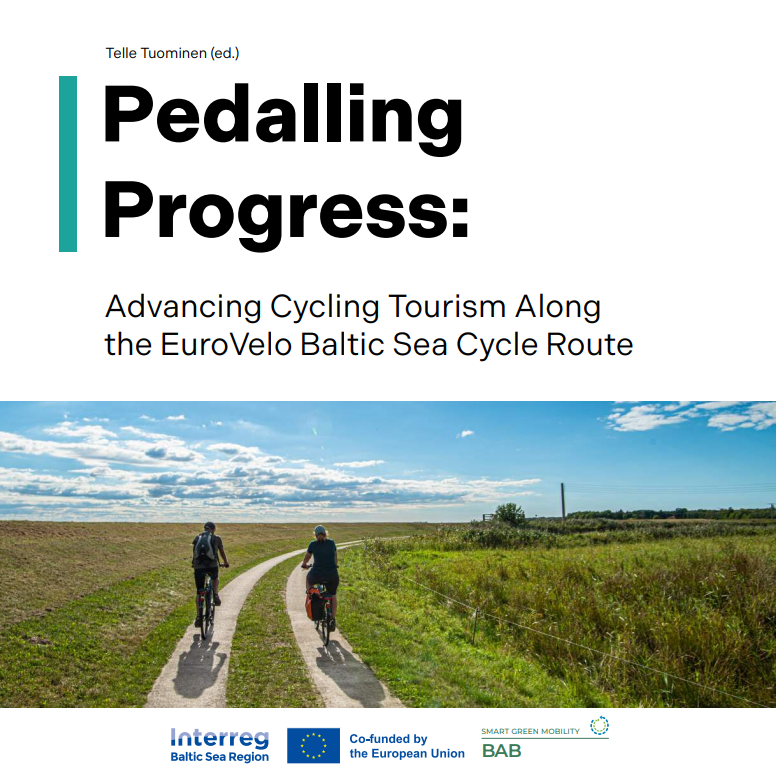
The Bike Across the Baltic (BAB) project is coming to an end – it’s the perfect moment to summarize what we’ve achieved over the last two years! The full article is available in English here: ARTICLE
Telle Tuominen, a tourism lecturer at Turku University of Applied Sciences (Project Leader), has compiled the experiences, activities, and achievements of our international project. In her article, she describes the development of the EuroVelo 10 international cycle route around the Baltic Sea, focusing on the results of the Bike Across the Baltic project, implemented between August 1, 2023, and July 30, 2025.
With the growing popularity of cycling as a sustainable means of transport and form of tourism, the BAB project is an important step towards promoting and improving cycling infrastructure in the region. The article presents the latest activities and their impact in the four partner countries: Estonia, Finland, Poland, and Sweden.
The report shows the current state of development of cycling tourism and specific activities carried out as part of the BAB project – from infrastructure investments to promotional and educational activities. It also identifies key factors conducive to the development of cycling routes, as well as strategic directions for further action, both for local governments and non-governmental organizations involved in sustainable mobility, as well as for the tourism industry and cyclists themselves.
Poland: The state of cycling tourism and the contribution of the BAB project
Poland supports the development of cycling tourism through national mobility, health, and climate policies. In the Pomorskie region, the development of cycling is strongly embedded in regional strategies, with an emphasis on active mobility and sustainable tourism. Many regions in Poland have been promoting cycling tourism for years. In June 2025, the Polish Tourist Organization submitted an application to the European Cyclists’ Federation (ECF) to establish a National Coordination Center (NECC) in Poland.
At the regional level, key players include the Pomorskie Tourist Board and the Marshal’s Office of the Pomorskie Province, as well as local non-governmental organizations and local governments. The strengths of cycling tourism in Poland include well-prepared seaside towns such as Ustka and Łeba, growing multimodality (e.g., ferry connections from Gdynia and Gdańsk), and the increasing involvement of local communities through campaigns such as “Cycling May.” The development and promotion of cycling routes is based on structured cooperation and many years of experience in implementing EU projects.
However, challenges remain, such as a lack of nationwide coordination, inconsistent route signage (especially in rural and forest areas), limited availability of cyclist-friendly services in remote areas, and the need to create dedicated cycling infrastructure in places where cyclists share the road with other vehicles.
What has the BAB project changed in Poland?
Thanks to the BAB project, the Pomorskie Tourist Board has carried out a detailed inventory of the EuroVelo 10 route in the regions of Pomerania, Warmia, and Masuria, covering a total length of 420 km. The key strengths of the route and areas for improvement were identified, particularly near the Słowiński National Park, where measures are needed to increase safety, improve signage, and provide adequate leisure infrastructure.
The BAB project also initiated new forms of cooperation between the departments of tourism, transport, and environmental protection in local governments, and raised awareness among tourism experts about the development of cycling tourism. The results of the project include: a Polish version of a comprehensive report on cycling tourism in the Baltic countries, along with good practices and recommendations, available here https:/ /prot.host3.jamel.com.pl/turystyka-rowerowa-w-regionie-morza-baltyckiego-rozwoj-wyzwania-i-najlepsze-praktyki/ , numerous regional workshops with stakeholders from local government units and cycling tourism experts, an international webinar on cycling tourism, which can be viewed here: https://www.youtube.com/watch?v=eyHD8WgVJUw, and thematic sessions on cycling tourism at the Baltic Tourism Forum organized by the Thematic Area Coordinators for Tourism of the EU Strategy for the Baltic Sea Region. Thanks to these activities, the EuroVelo 10 route is becoming increasingly attractive to foreign tourists, and the results obtained provide valuable guidance for future actions at the regional and, soon, national level.
We encourage you to read the full article in the Solutions tab on our website – https://interreg-baltic.eu/project/bab/